
ACT's 'visually misleading' post: Is it a graphic or a graph?
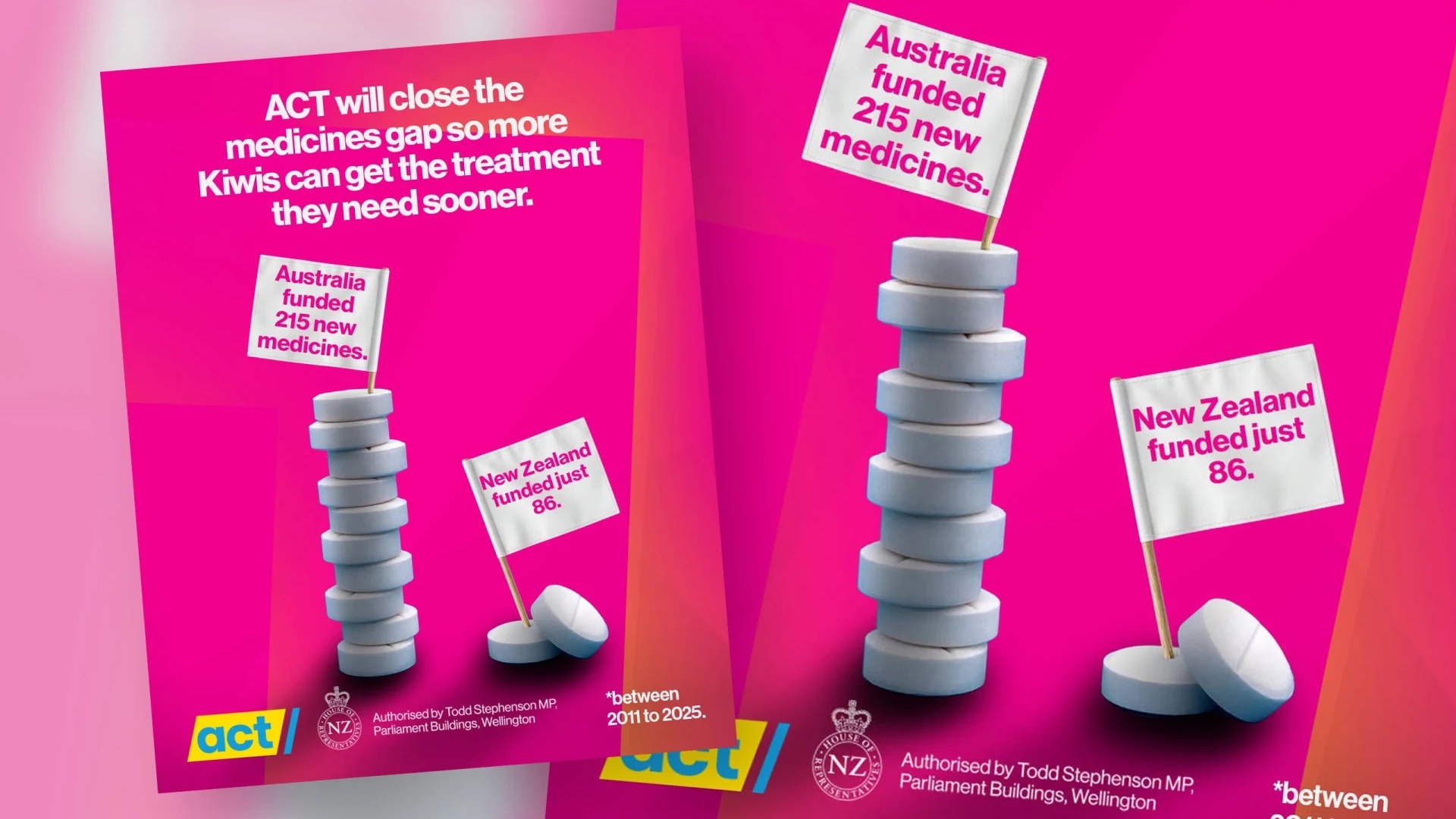
A social media graphic posted by the ACT Party. (Supplied photo)
"You've got one big stack, and one small stack. You look at that and go, those are comparable."
An ACT Party post about the gap between new medicines funded in Australia and New Zealand is "visually misleading," according to a statistics professor.
The post on the ACT party's Facebook page shows two stacks of pills and says Australia has funded 215 medicines between 2011 and 2025, while New Zealand has funded 86. Australia is represented with a stack of 10 pills and New Zealand has just two pills.
Professor Thomas Lumley, a biostatistician at the University of Auckland, says the difference between the pill stacks depicted is 5 times, when it should be 2.5 times.


The ACT party's press secretary for Todd Stephenson denied the post was misleading saying it was a "graphic and not a graph". It aimed to show the gap between Australia and New Zealand's funding of new medicines.
But most people would interpret the graphic as a graph, according to Lumley, who said it was "clearly giving bar charts".
South Asian diaspora raises over $200,000 for New Zealanders missing in Nepal flood "I'm so proud of the Indian community here who...supported us, saying it is not a Nepal problem but our problem."
Tamakis launch Indian-origin candidate for Epsom who surrendered passport and has ‘assimilated’ “I know a whole lot of people are going to be like shocked,” says Hannah Tamaki.
Priyanca Radhakrishnan tries to puncture Luxon’s FTA victory, says India was already sold “Things have changed quite dramatically on the Indian government side,” says the Indian-origin Labour MP.
"People do graphs like that, it's a decorative way of doing a bar graph."
People viewing it this way would have an incorrect reading of the actual difference, he said.
"I would say this ad is visually misleading."
He couldn't say if it was poor design, or deliberate.
"It may even be deliberate in taking advantage of the fact it can be passed off as bad design."
Presenting numerical data inaccurately detracted from meaningful political discussion, Lumley said.
RNZ could not independently verify the medicine figures in the post, and ACT did not cite a source.
Dylan Reeve takes an interest in disinformation and is the author of Fake Believe: Conspiracy Theories in Aotearoa.
In 2019 he complained to the Advertising Standards Authority (ASA) about a National party advertisement relating to fuel prices.
The ad also included a bar chart which was incorrectly scaled and visually exaggerated the price under Labour. The advertisement was eventually ruled as acceptable, although the ASA labelled it "mischievous" and said it had the potential to cause confusion.
The ASA assesses advocacy advertising, which includes political advertising, differently to other types of advertising. It says this is because the ads promote the view of the advertiser, rather than a product or service.
It makes an allowance for opinion, as long as opinion is clearly separated from fact.
At the time, its chief executive Hilary Souter told RNZ she agreed the graph bars didn't match the numbers but that this was National's interpretation of information: "The majority of the board felt the numbers in this ad were very clear, it's impossible to miss them even if you choose to also at look the representation of these bars."
Policing our politicians for porkies (24 min 7 sec)
Reeve, however, said political parties should hold their advertising to a high standard.
"It's being carried out by people who are asking us to trust them with the operation of the country. I think we should demand of them accuracy, honesty and forthrightness in how they make that pitch to us."
Reeve agreed most people would interpret ACT's post as a chart because it used the "language of data".
"You've got one big stack, and one small stack. You look at that and go, those are comparable."
With two pills representing 86 medicines for New Zealand, the ten pills representing Australia would equate to 430 medicines, far greater than the 215 the sign on the pile of pills states.
ACT's post was not a paid advertisement. At present, social media posts don't fall under the remit of the ASA, but Reeve felt other advertising circulating at present, such as National's advertisements stating "Triple your taxes" could mislead people.
The ASA has received 72 complaints about National's tax tripling ads, but has not upheld them saying the ad is a statement of political opinion. All of its five decisions this year related to political ads have involved National. One complaint was settled and the remaining four weren't upheld. Souter said the ASA has not received any complaints about ACT's post.
ACT also hasn't received direct complaints about the depiction of pills in its post.
Stephenson's press secretary said negative comments on the post suggesting the graphic is "deceptive", "misleading" and "distorts" the truth hadn't been addressed because the party doesn't respond to "every single person with too much time on their hands".